
Antonio Romero:
TROPICALIA [VOL2]
Starting March 29, 2026
Curated by: Gabriela Urtiaga, MOLAA Chief Curator
The Museum of Latin American Art is pleased to present the first solo exhibition in the United States of Salvadoran artist Antonio Romero, whose works are part of the collections of MOLAA and the Museo Reina Sofía in Spain.
Through his series TROPICALIA, Romero unfolds a poetic and critical approach that situates itself within a tradition of contemporary art that understands landscape not as an autonomous genre nor as an exercise in mimesis, but as an ideological construction. The project questions the processes of landscape standardization and presents it as a staged space.
The artist begins with a forceful premise: the tropical landscape has been transformed into a postcard. This image, far from innocent, operates as a device of symbolic simplification that erases cultural, social, and political complexities in order to produce a consumable image. In TROPICALIA, the painting occupies that point of friction between representation and artifice. The horizon, a central figure in the tradition of landscape painting, loses its promise of transcendence and appears interrupted, destabilized. The blue that emerges across the surface does not refer to the sky or the sea; it functions as an interference that disrupts any romantic reading.
The use of different scales and supports—both in landscapes and portraits—reinforces the political implications of the project. The violence that runs through the series is not explicit, but structural: through erasure and the loss of information, the images cease to be places of refuge and instead become spaces of tension. The exhibition proposal amplifies this critique, incorporating the viewer into a dispositive in which looking implies taking a position in relation to the images we have normalized.
This exhibition is organized by MOLAA’s Chief Curator together with IMLS fellows Adela Arriola (UCLA) and María Tapia (CSULB).
Biography
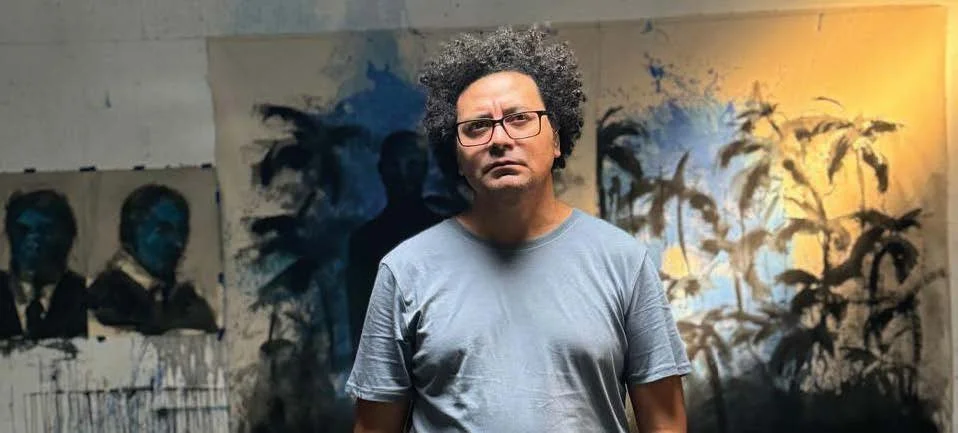
Antonio Romero
Antonio Romero (El Salvador, 1978)
Multidisciplinary artist who combines his artistic practice with curatorial work. He holds a degree in Fine Arts with a specialization in painting. His work was recently on view in the section Dispositivo 92: Can History Be Rewound? at the Museo Reina Sofía through the end of 2025, and in Trópico Telúrico at the Museo de Arte de El Salvador through 2026.
His work is included in international public and private collections such as the Museo Reina Sofía (Spain), the Mario Cader-Frech Collection (United States), the Museum of Latin American Art (MOLAA) (United States), the Fondazione Imago Mundi (Italy), the Llorente y Cuenca Collection (Spain), and the Fundación Rozas Botrán (Guatemala).
He has presented eleven solo exhibitions and participated in numerous group exhibitions in El Salvador, France, the United States, Canada, Nicaragua, Costa Rica, Guatemala, and Spain, in institutions and spaces including the Museo de Antropología and Museo de Arte de El Salvador, Galería EXTRA (Guatemala), Museo de Arte y Diseño (Costa Rica), Kates Ferri Project Gallery (New York), and Galería Memoria (Spain), among others.
He has received several recognitions, including the Y.ES Artist Academy Fellowship from the Y.ES Contemporary Foundation in 2022. Additional awards include First Place in the Contemporary Painting Salon (El Salvador, 2016); Second Place in the IX Young Art Prize (El Salvador, 2008); First Place in the XX Diplomat Palmarés (El Salvador, 2004); First Place in the III Young Painting Prize (El Salvador, 2002); and Second Place in the Latin American Art Auction and Competition “Juannio” (Guatemala, 2002).
Artist Statement
My work emerges from the context of and acts as a response to power and its narratives. Painting, as the primary medium in my practice, is not intended to be ornamental, but rather conceptual and political, engaging with memory and social trauma.
I am currently developing two “sister” series, connected through their narrative continuity:
“Navarone” constructs unsettling scenes with anonymous figures that thicken the atmosphere, creating a psychological link between the works and their viewers. The everyday nature of “Navarone” contrasts with the normalization of violence, and through faces covered with balaclavas, it functions as a mirror of seemingly ordinary lives in their ambivalent roles as either victims or perpetrators.
“Tropicalia” is approached through landscape as a fictionalized setting, operating as a metaphor. The audience becomes another character within an atmosphere conceived as an installation. Through a horizon of landscapes rendered on large-scale canvases, the works create an installation-like environment (as a staged setting) that incorporates viewers as “characters,” so that the painting itself is not the exhibition, but rather the atmosphere in which the viewer becomes the one on display.