Highlights of the MOLAA Collection
BEATRIZ GONZÁLEZ
(Colombia, 1932)
A la salida del Camerino, 1989
Oil on paper
59 x 39 inches
Accession: 2021
ABOUT THE ARTWORK
Following the Palace of Justice Siege of 1985—a major confrontation between leftist guerrillas and the Colombian army that resulted in dozens of casualties—González began to turn to more overtly political subject matter, without losing the surreal quality and frequently ironic tone of her previous work. A la salida del Camerino operates in this space, fusing the fabulous aesthetics of high fashion—its Spanish title translates to “At the dressing room exit”—with the military imagery that has played an all-too-prominent role in the nation’s violence plagued history. At the same time, this relatively late painting, produced nearly three decades into the artist’s career, sees González pushing several formal elements to new extremes. The cramped positioning of the figures suggests multiple perspectives combined into the same picture plane, an effect amplified by the broad swathes of color defining both figures and the scene’s depthless background. Through this combination of formal experiment and social commentary, A la salida del Camerino marks a transition to a newer more brash phase of González’s career, critiquing not only the classism and sensationalism of popular Colombian media, but also its implication in the nation’s troubled climate of political violence.
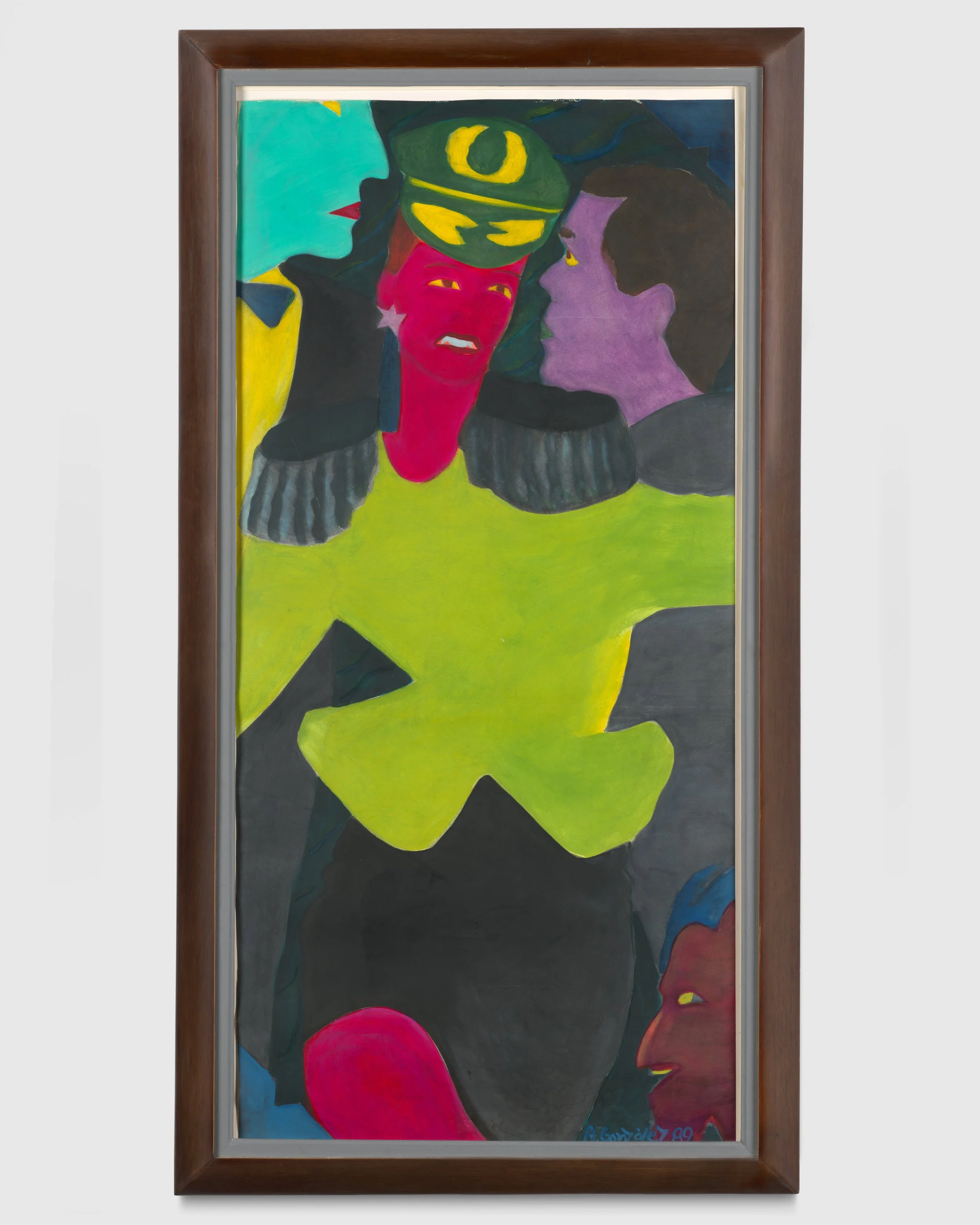
Beatriz González, A la salida del Camerino, 1989
BIOGRAPHY
Born in the rural Colombian town of Bucaramanga, González completed her studies in art at the University of the Andes in Bogotá in 1962. Two years later, she had her first solo exhibition at the Museo de Arte Moderno de Bogotá (MAMBO), presenting a sequence of abstracted reimaginations of Johannes Vermeer’s The Lacemaker (1665) influenced by the Abstract Expressionist work she had seen on a university visit to New York and Washington D.C. in 1960. Heralded by Marta Traba, an influential Argentinian art critic who was also MAMBO director and a former professor of González’s, this show catapulted González to prominence and established something of a template for the artist’s work, which has been compared to pop art for appropriation of imagery from diverse sources, both art historical and from the pages of popular media. Rather than painting on a traditional support like canvas, González began placing her appropriated portraits upon furniture, evoking the readymade tradition pioneered by Marcel Duchamp. Whether reproducing the iconic works of Renaissance masters or salacious crime scene photography, González’s work frequently treated its subjects with irreverent wit, for example cartoonishly reproducing Leonardo da Vinci’s The Last Supper (1495-1498) on a coffee table as La última mesa [The last table] (1970). In addition to her work as an artist, González has served as curator of the art and history collections of the National Museum of Colombia, as well as a member of the acquisitions committee for Colombia’s Banco de la República. Her work is in the collections of the Museo de Arte Moderno de Bogotá, MoMA, and Tate Modern, among numerous other institutions.