Highlights of the MOLAA Collection
DAVID ALFARO SIQUEIROS
(Mexico, 1896-1974)
Heroic Voice, 1971
Lithograph
23 x 17.25 inches
MOLAA Permanent Collection. Gift of the Mongan Family.
Accession: 2009
ABOUT THE ARTWORK
Heroic Voice depicts the Mexican American journalist Ruben Salazar, who was killed by police during a Chicano Moratorium protest of the Vietnam War on August 29, 1970, in East Lost Angeles. A reporter for the Los Angeles Times, Salazar was one of the few journalists to consistently cover the Chicano Movement of the 1960s and 70s and was elevated to the position of martyr after he was struck in the head by a tear gas canister while sheltering inside a bar near the protest. Siqueiros had a long history in Los Angeles, having completed three mural commissions in the city in 1932: Portrait of Mexico Today, Street Meeting, and América Tropical. These murals were met with local outrage due to their frank depictions of class conflict, interracial relationships, and U.S. imperialism, with Street Meeting and América Tropical being painted over soon after their completion. The latter was rediscovered by the Chicano Mural Movement during the 1970s, whose efforts to restore the mural were captured in a 1971 documentary by Jesus Salvador Treviño. While best known as one of the ‘tres grandes’ muralists alongside Diego Rivera and José Clemente Orozoco, Siqueiros had experimented with lithography since the 1920s, frequently reproducing or appropriating imagery from larger projects. Heroic Voice’s female nude figure struggling in chains was taken from the central panel of his Nueva Democracia mural (1944-45) in Mexico City’s Palace of Fine Arts.
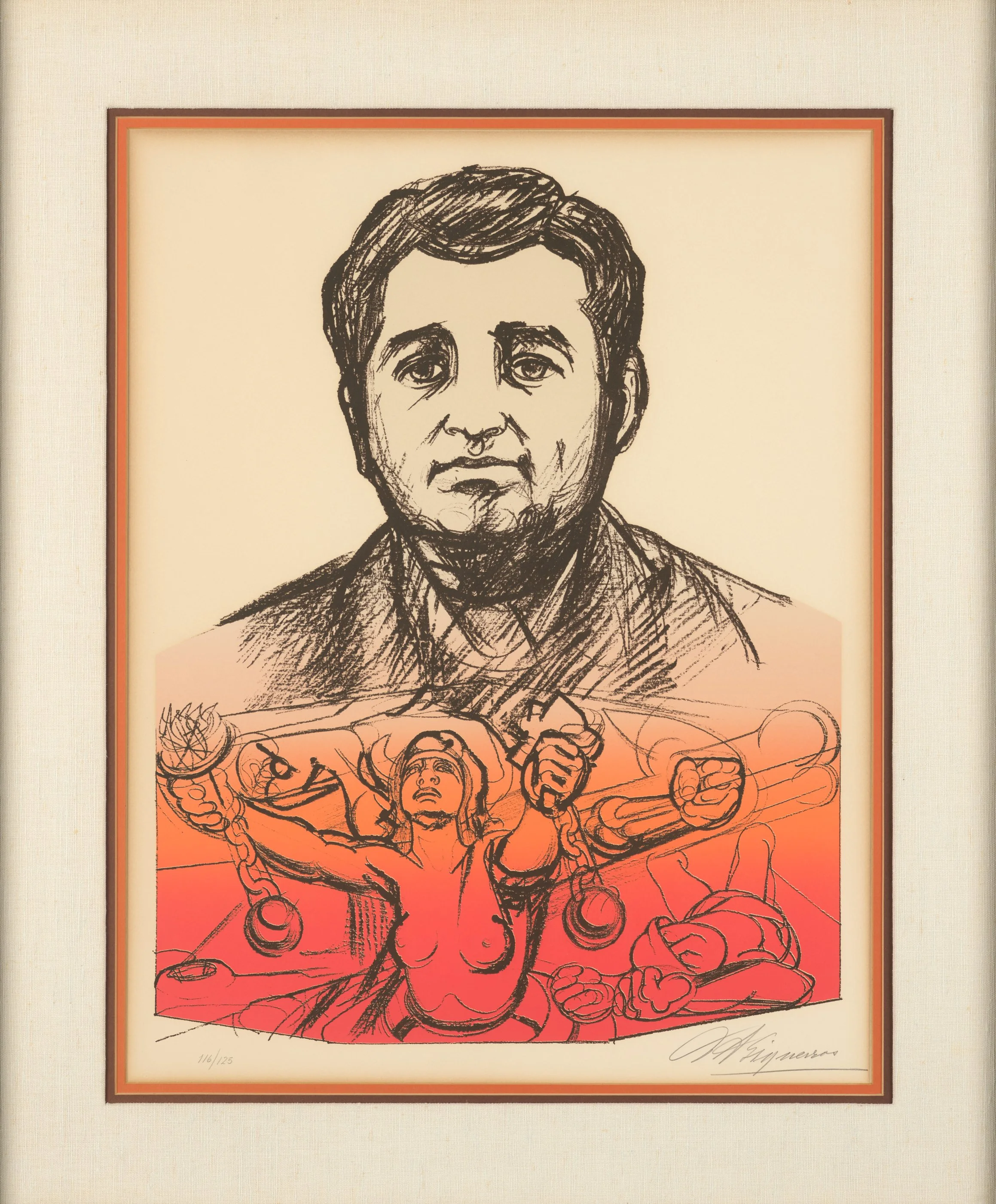
David Alfaro Siqueiros, Heroic Voice, 1971
BIOGRAPHY
David Alfaro Siqueiros was born in the Mexican state of Chihuahua in 1896. As a young man, he took up arms to fight in the Mexican Revolution. Alongside Diego Rivera and José Clemente Orozco, Siqueiros completed major public mural commissions as part of the post-revolutionary government’s education program under the direction of minister of education José Vasconcelos. Among his generation, Siqueiros was known for introducing new techniques into muralism, such as airbrush painting and cement-based mural surfaces—innovations explored in the two outdoor murals he completed in Los Angeles in 1932—and later the direct projection of images onto the wall to create complex multi-perspective compositions. A committed communist, Siqueiros maintained both avant-garde and political connections throughout the world, executing murals in Argentina, Chile, and elsewhere. He founded the Siqueiros Experimental Workshop in New York in 1936, through which he pursued new automatic painting techniques, dripping and pouring paint directly onto a canvas positioned horizontally on the ground. One Workshop attendee was a young Jackson Pollock, who would go on to incorporate many of these methods into his own Abstract Expressionist work. Imprisoned multiple times for his criticism of the government, Siqueiros would exert a major influence not only upon the Chicano Mural Movement in the United States, but also the Mexican art collectives known as the Grupos that emerged in the 1970s as important critical voices of the dominant Institutional Revolutionary Party (PRI).