Highlights of the MOLAA Collection
ANA MENDIETA
(Cuba, 1948-1985)
Volcán, 1979
Super-8mm film transferred to high-definition digital media, color, silent,
3:11 minutes.
MOLAA Permanent Collection.
Accession: 2021
ABOUT THE ARTWORK
Filmed following the completion of Mendieta’s MFA degree at the University of Iowa, Volcán depicts what appears to be a human figure—a mummy-like shape consisting of an unidentified white material nestled into a raised pile of earth reminiscent of the rim of a volcano. Following an in-camera jump-cut, the Super-8 footage shows the white material—gunpowder—begin to emit smoke, burst into flame, and be quickly consumed, leaving a black residue of ash. Volcán inserts the figure into the natural landscape, offering a human-scaled rejoinder to the roughly contemporaneous Land Art movement’s monumental Earthworks. Mendieta reuses the work’s somewhat yonic form and the practice of burning from her Silueta Series, but the metaphor of the volcano here carries specific connotations. As Howard Oransky has pointed out, the explosive force of the volcano embodies the dual significance that Mendieta, a political refugee at 12, invested in earth across her career: at once a source of maternal comfort and a simmering threat of violent rupture and dislocation. The film’s setting on the banks of a body of water—a metal pole in the upper right corner of the frame suggests a mooring for an unseen watercraft—only furthers the work’s association with the artist’s formative displacement from her island home.
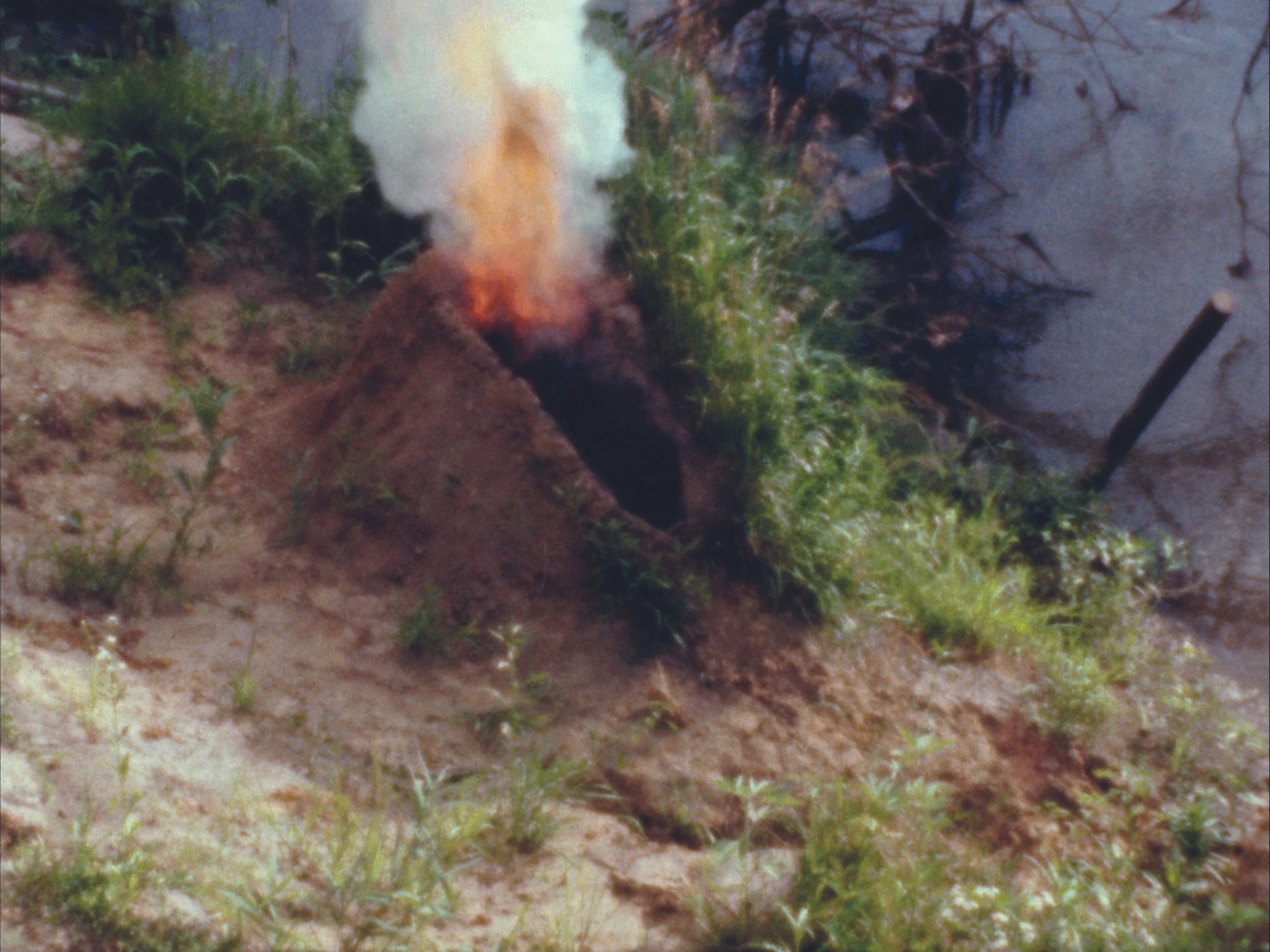
Ana Mendieta, Volcán, 1979
BIOGRAPHY
Ana Mendieta was born in Havana, Cuba in 1948. In 1961, two years after the Cuban Revolution, Mendieta and her sister were flown to the United States—two of around 14,000 children sent out of Cuba through “Operation Peter Pan,” an evacuation effort led by the Catholic Church, though encouraged by the CIA. Ending up in Iowa, Mendieta and her sister spent years shuttled between foster homes and orphanages before reuniting with their mother and brother in 1966. Jailed by the Castro regime until 1972, Mendieta’s father would not arrive in the United States until 1979, dying soon thereafter. Mendieta completed a bachelor’s degree in painting at the University of Iowa and then enrolled in the newly founded Intermedia MFA program led by Hans Breder, an early influence on her work. Moving to New York in 1978, Mendieta was affiliated with the feminist cooperative art gallery, Artists in Residence (A.I.R.). Much of Mendieta’s practice—which spanned performance, video, and sculpture, among other media—was centered around the female body, with the artist herself appearing in many of her works. Mendieta’s art examined patriarchal violence, including a series of early performance and video works responding to the 1972 rape and murder of a female University of Iowa student. Mendieta was also interested in pre-Columbian cultures and Caribbean religious traditions, especially after returning to visit Cuba for the first time since her childhood in 1980. Mendieta died under tragic circumstances in 1985, falling more than 30 stories from the window of her New York apartment. While he was acquitted by a judge in 1988, many believed her husband, the famed minimalist sculptor Carl Andre, to have been responsible.