Highlights of the MOLAA Collection
CARLOS CRUZ-DIEZ
(Venezuela, 1923 – France, 2019)
Cromointerferencia, 2006
Mixed media
20 in. x 20 in. (50.8 cm x 50.8 cm).
MOLAA Permanent Collection. Gift of The Albertella Family Trust.
Accession: 2016
ABOUT THE ARTWORK
Cromointerferencia illustrates Cruz-Diez’s career-long preoccupation with the perception of color. His work was deeply embedded in color theory, in particular Josef Albers’s research into the ways colors interact when perceived by the eye, rarely appearing as the exact hue they “truly” are. This is the same logic behind the late 19th century painting movement of Pointillism, which used color theory to compose scenes out of fields of tiny dots that nevertheless produce the appearance of natural color gradations due to the eye’s instinct to (in this case literally) “fill in the dots”. The Cromointerferencia series operates by a similar principle, although using lines instead of dots: the vertical pattern of lines on the transparent top layer interacts with a similar design on the substrate to generate a shifting field of shape and color. In this work, the overlapping shapes of three thick rings function as constantly changing color wheels as the viewer changes positions in front of the artwork.
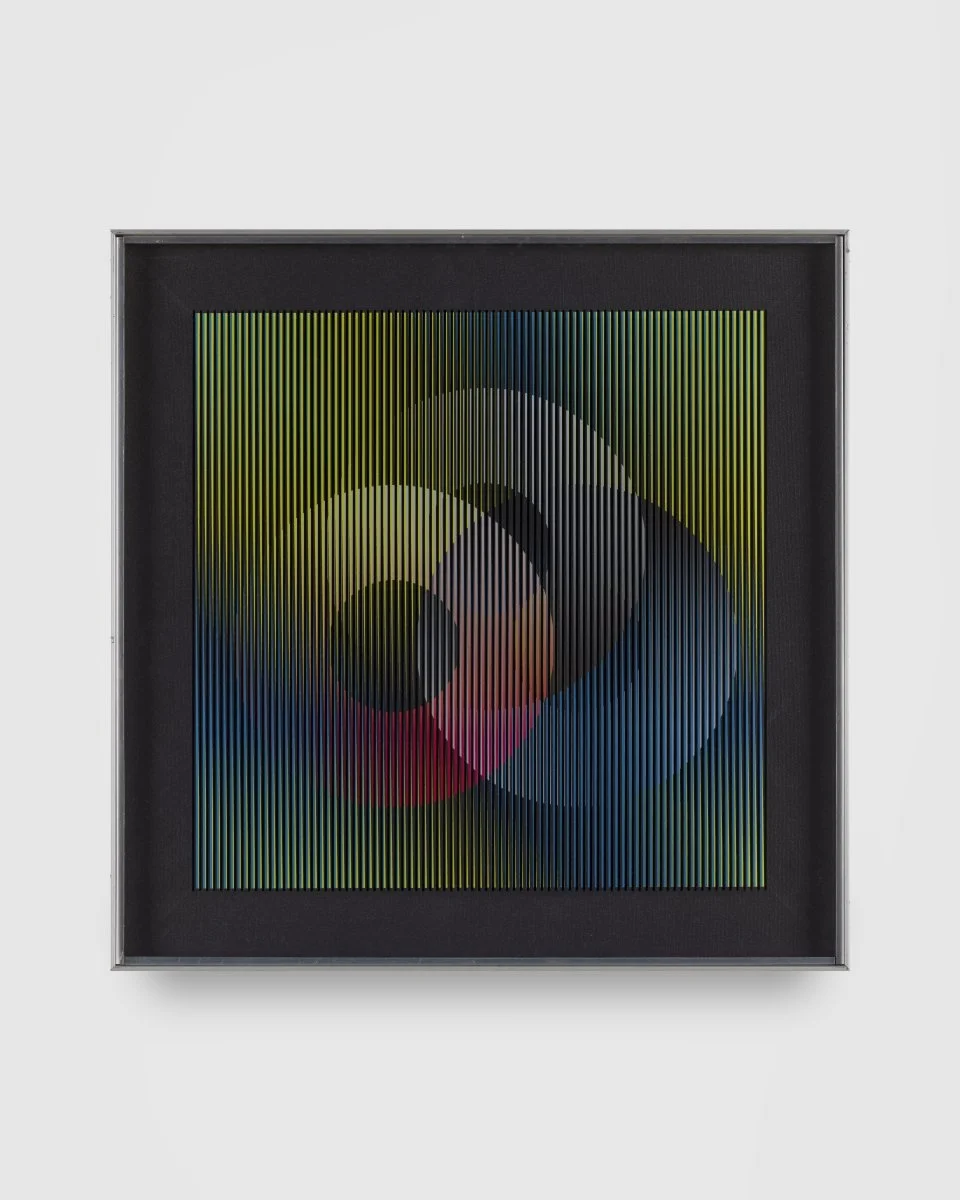
Carlos Cruz-Diez, Cromointerferencia, 2006
BIOGRAPHY
Born in 1923 in the Venezuelan capital of Caracas, Cruz-Diez studied at the Escuela de Artes Plásticas y Aplicadas from 1940 to 1945 alongside such prominent artists as Alejandro Otero and Jesús Rafael Soto. Like many of his Venezuelan compatriots, Cruz-Diez traveled to Paris as a young artist, arriving in 1955 just in time to see the Le Mouvement exhibition at Denise René Gallery. This exhibition featured major figures associated with the incipient Kinetic Art movement, including Alexander Calder, Jean Tinguely, and Soto. Since the late 1950s, Cruz-Diez’s practice took the form of a series of deliberate experiments with the human perception of light and color. His earliest kinetic works, the Physichromie series, function through the placement of slightly raised vertical strips on a flat substrate. The painted sides of these ridged strips interact with the colorful pattern of the substrate to generate a shifting illusion of colors, including those not actually present anywhere on the artworks. The Physichromie is but one of several lines of investigation pursued by Cruz-Diez over a long career. Like several of his contemporaries, Cruz-Diez eventually began to experiment with large-scale immersive artworks, like the architectural Chromosaturation series, which took the form of entire sequences of rooms bathed in monochromatic light. After a handful of years back in his native Venezuela, Soto returned to Paris in 1960, where his workshop was based for the remainder of his career. His work can be found in the permanent collections of the Centre Pompidou (Paris), Museum of Contemporary Art (Los Angeles), the Hirshhorn Museum and Sculpture Garden (Washington, D.C.), and others.