Highlights of the MOLAA Collection
FANCESCO MARIOTTI
(Switzerland, 1943-2026)
Gran Guacamayo Precolombino, 1992
Electric installation
Dimensions variable
MOLAA Permanent Collection. Gift of Francesco Mariotti.
Accession: M.2025.012.001
ABOUT THE ARTWORK
The work of Mariotti looks at the intersections between art and technology. He uses diverse and unconventional materials including industrial recycled materials. Through experimentation,Mariotti reuses these objects for the construction of sculptural pieces that demonstrate the relationship between us and our environment.
Gran Guacamayo Precolombino is a techno-zoomorphic sculpture made of industrial materials and recycled technology- four monitors, four Commodore AMIGA computers, motion sensors, and metallic ventilation tubes. Inspired by forms and primary colors (green, yellow, red, and blue) predominant in Amerindian cultures and objects, Mariotti created an almost 10 feet tall mechanical bird.
“Guacamayo” is the Spanish word for “macaw,” a large, colorful parrot, with origins tracing back to Quechua or Nahuatl (native languages in Central and South America). This bird symbolizes beauty and power in ancient cultures but also became a symbol of Latin American exoticism during the colonial period. Gran Guacamayo Precolombino produces sounds that evoke the tropical landscape until its sensors detect the presence of the spectator. It then moves its “arms” and begins to speak randomly generated words from a selection of 12 living languages that are on the road to extinction. The mechanical bird uses a software called Chullachaqui 5 developed by Chilean computer technician Manuel Rodríguez. Mariotti explains that Chullachaqui is a word in Quechua that defines beings invented by witches. The Chullachaqui are considered small demons, but they are amicable and try to befriend human beings. Chullachaqui 5, therefore, allows the friendly techno-zoomorphic bird to try and express itself. However, the words are spoken with a foreign accent and in a language not understood by the spectator.
Mariotti’s friendly techno-zoomorphic bird was constructed using technology and artificial intelligence that functions with a program designed to establish contact with spectators through computer technology. This work situates itself in relation to history and the initial incomprehension and language barrier that characterized the first contact between Europeans and Indigenous communities in the Americas. The native people spoke different native languages including Aymara, Quechua, and Nahuatl, before the arrival of Europeans. However, after contact, Castilian was imposed in the territories colonized by the Spanish Empire. This work, therefore, sheds light to this historical moment while also calling attention to the endangered native languages in Latin America.
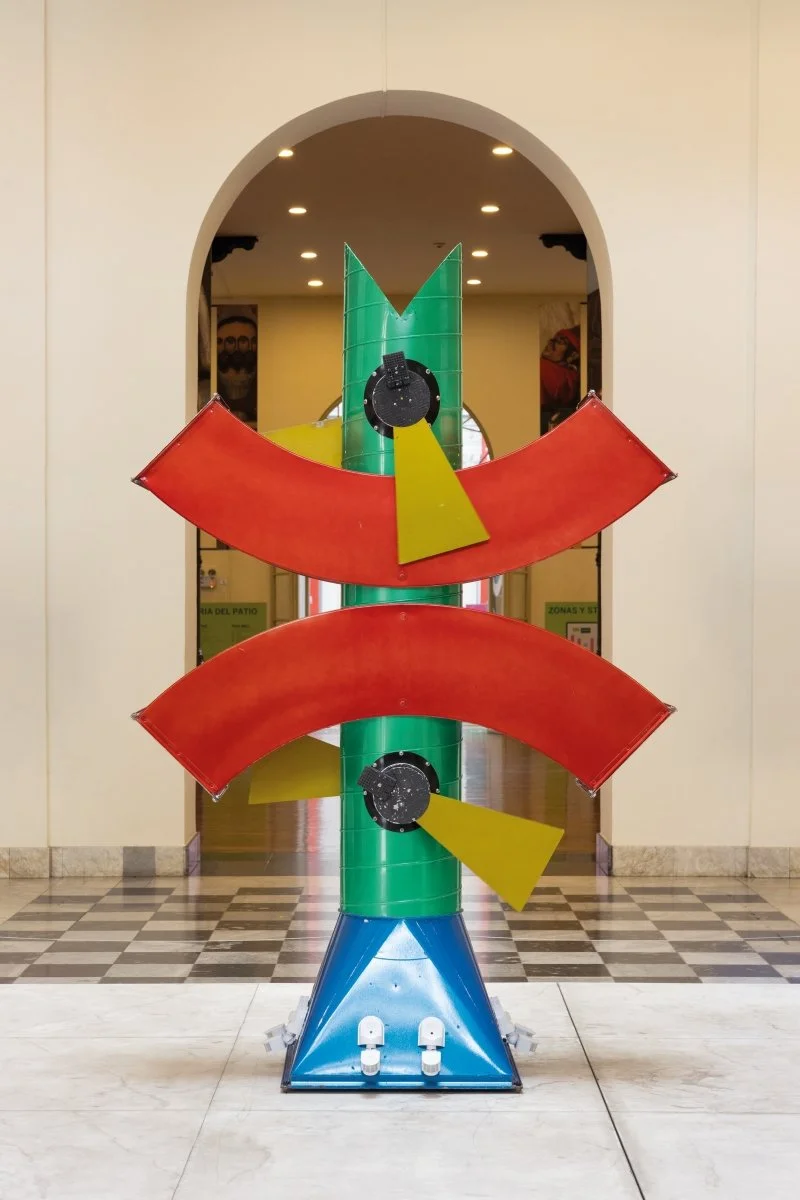
Francesco Mariotti, Gran Guacamayo Precolombino, M.2025.012.001
BIOGRAPHY
Francesco Mariotti was a Swiss-Peruvian artist and pioneer in art and technology, interested in the relationship between social processes, natural phenomena, and technological tools. He was born in Bern, Switzerland in 1943 and grew up in Lima, Peru after moving there in 1952. From 1965 to 1968 he studied at the Hamburg Academy of Fine Arts in Germany focusing on the complex relationship between art, nature, and technology. After graduating, he participated in the 4th Documenta in Kassel, Germany (1968) and in the X São Paulo Biennial, representing Switzerland (1969).
Mariotti returned to Peru in the early 1970s, where he taught at the Art School in Lima and developed various experimental social and participatory projects. He experimented with the possible interactions between electronic and IT devices and the creation of multi-sensorial installations and works. In 1981 he moved back to Switzerland, where he began a systematic work linked to the creation of light and kinetic sculptures, also known as techno-sculptures or “techno-zoomorphic” sculptures. These are metallic structures linked to nature, to which circuits, sensors and computers are added, generating a bricolage that creates the perception of a living creature (some recite poetry, others speak, etc.).
Since the late 1990s, Mariotti’s work has established a dialogue with nature, from Andean and Amazonian oral traditions and myths to the confrontation with complex processes such as climate change and ecology. He uses diverse materials, including industrial recycled materials, and repurposes them through experimentation. He constructs sculptural pieces that reveal the relationship between us and the environment. His work invites us to reflect on the links we have with nature, science, technology, and art and asks us to contemplate our place in the world—as part of an ecosystem and community.
His works have been exhibited internationally including the Museum of Latin American Art (MOLAA), Long Beach, CA, as part of Arteônica: Art, Science, and Technology in Latin
America Today, organized by MOLAA as part of the Getty PST Art: Art & Science Collide and curated by Gabriela Urtiaga, MOLAA Chief Curator. The exhibition explored the relationship between art, science, and technology that expanded across Latin America in the 1960s and 1970s, in which artists framed the computer as an instrument for positive societal change capable of democratizing art and culture. The exhibition explored the history and presence of electronic art from Argentina, Brazil, Chile, Peru, and Mexico and highlighted how artists like Mariotti laid out the foundations for production inspired by the most innovative concepts of their time.