Highlights of the MOLAA Collection
JOAQUÍN TORRES-GARCÍA
(Uruguay, 1874-1949)
Composición constructiva, 1934
Ink on paper
6.875 x 5.5 inches
MOLAA Permanent Collection.
Accession: 2010
ABOUT THE ARTWORK
Composición constructiva dates to the year of Torres-García’s return to his native Uruguay after more than four decades of absence. Its composition embodies the artist’s signature style: a grid system partitioned and populated by a collection of two-dimensional objects rendered in a crude iconography. The drawing includes many motifs that recurred in Torres-García’s work: a sun—a reference both to ancient practices of sun worship in Egyptian and Inca cultures and to the Uruguayan flag—fish, clock, ship, and a schematic male-female dyad in the upper left. While the work abounds with autobiographical references to the artist’s trans-Atlantic journey to his country of origin, Torres-García’s “constructive universalism” in fact aspired to a universal symbolic language that would transcend time, space, and culture. Torres-García sought to blend the formal tendencies of modern art—most notably the grid, which famously structured the “neoplasticist” paintings of Piet Mondrian and Theo van Doesburg, with whom Torres-García interacted during his six years living in Paris—with the visual traditions of pre-Columbian American peoples, particularly the geometric designs found in Andean civilizations. While the handwritten note scrawled across the bottom of the drawing belies its finished character, the sketchy linework and monochromatic character of this work are typical of Torres-García’s painted “constructions,” as well.
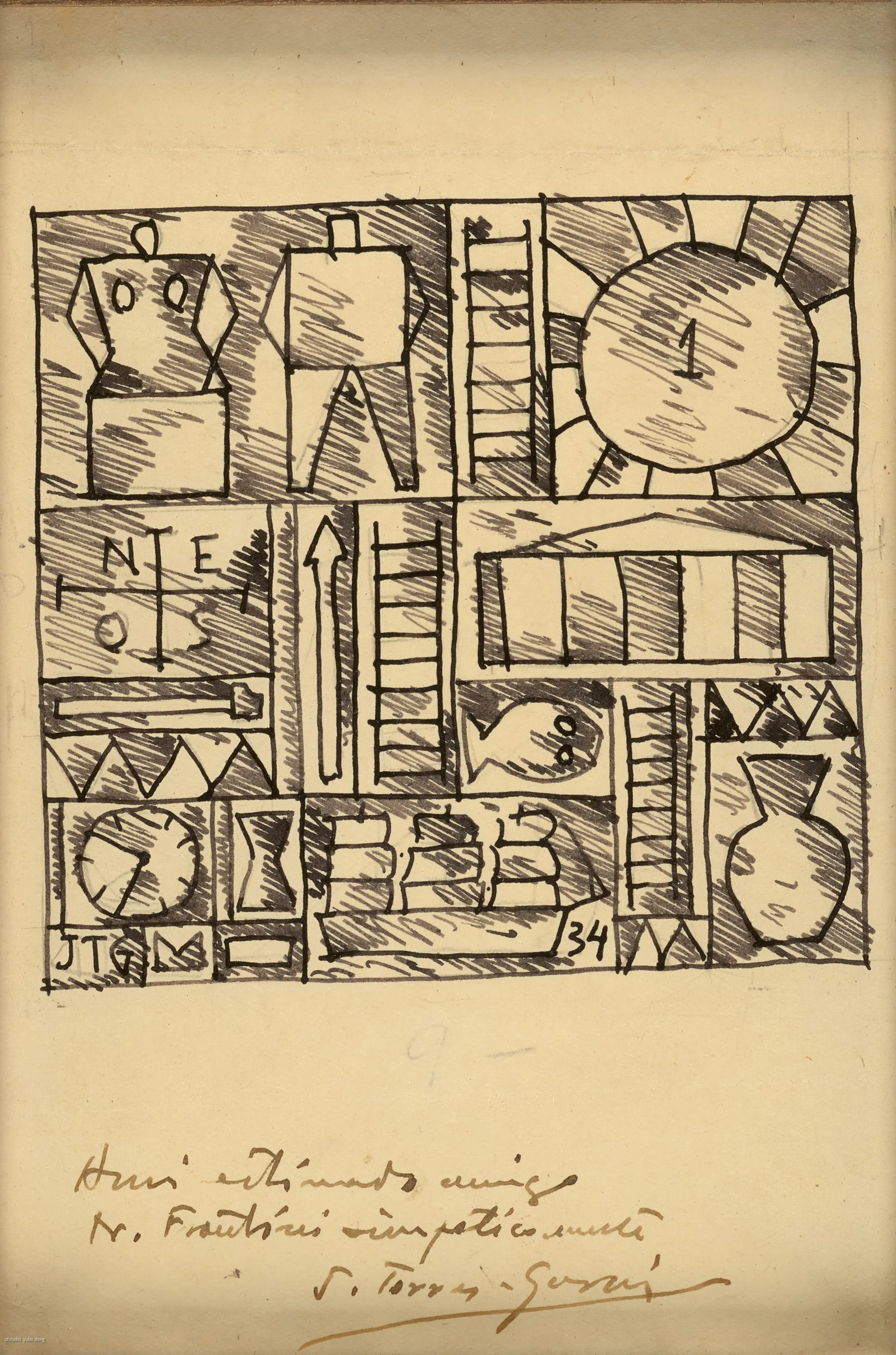
Joaquín Torres-García, Composición constructiva, 1934
BIOGRAPHY
Joaquín Torres-García was born in Montevideo, Uruguay to a Spanish Catalan father and a Uruguayan mother. His parents moved the family to Spain when Torres-García was just 17; he would not return to his native country, where he would achieve his greatest notoriety as an artist, for 43 years. As a young artist in Barcelona, Torres-García was associated with the Catalan “Noucentisme” art movement, executing a series of frescos allegorizing Catalan identity during the 1910s. He shifted from this polished classical imagery to more identifiably “modern” paintings of contemporary urban scenes in the subsequent years, particularly during a period spent in New York City between 1920 and 1922. Following several years moving between various rural settings in Italy and France, Torres-García settled in Paris in 1926, where he spent six extremely productive years methodically developing the iconographically-laden style that would define his mature works. In Paris, he met Piet Mondrian and Theo Van Doesburg—artists who pioneered pure abstraction via “neoplasticist” grid paintings consisting of cleanly applied blocks of primary colors—and cofounded an artist group and publication titled Cercle et Carré (Circle and Square) with the Belgian writer Michel Seuphor. Unlike his neoplasticist peers, Torres-García incorporated representational imagery into his paintings in the form of a purportedly universal iconic vocabulary drawn from multiple world traditions. Upon returning to Uruguay in 1934, Torres-García promoted modern art in the country through the founding of several institutions: the Asociación de Arte Constructivo artist center and exhibition space (which lasted from 1935 to 1940) and the Taller Torres-García, a Bauhaus-style academy founded in 1943 that continued to promote the artist’s “constructive” approach to art and design until 1962, 13 years after the artist’s death.